
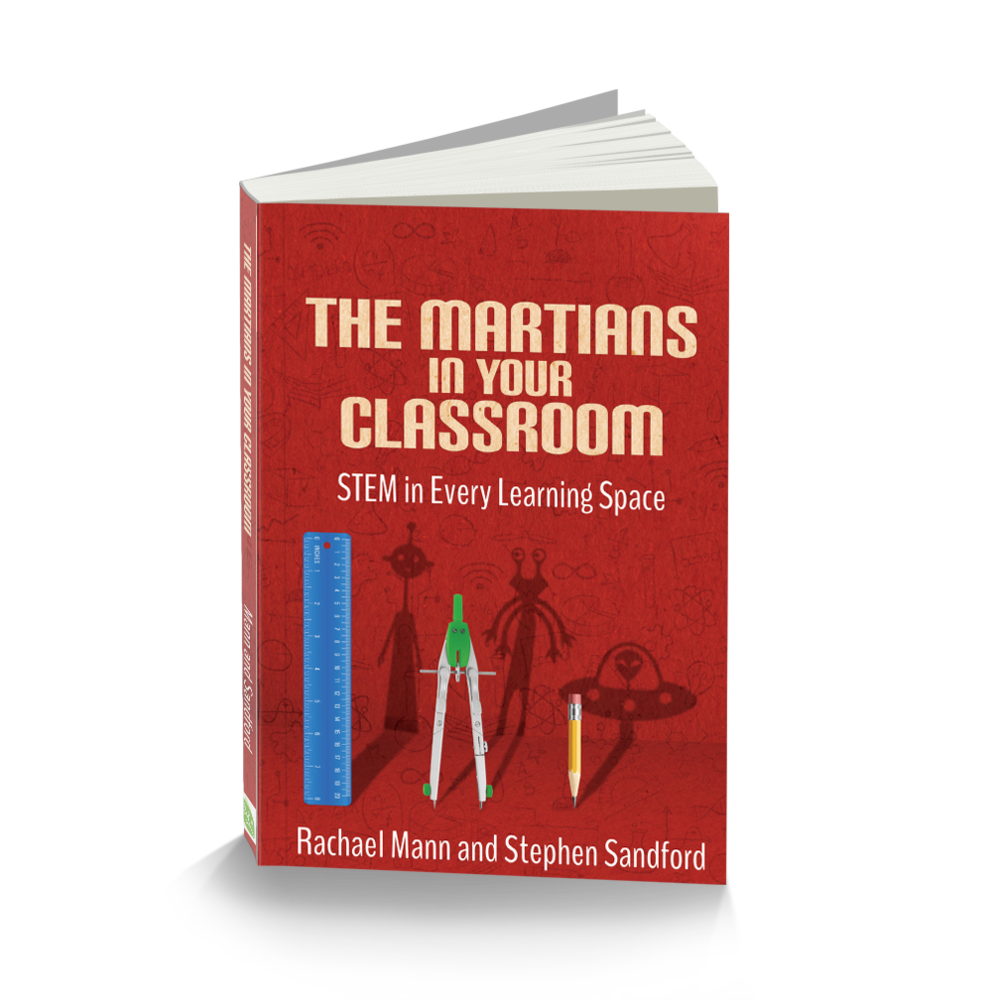
It all started when…Rachael’s Story
In January 2017, on a short flight from my home in Phoenix to Los Angeles, I was disappointed to discover that the flight wasn’t Wi-Fi equipped and I hadn’t brought reading materials for the trip. I pulled out the Southwest Air magazine from the back of the seat in front of me and flipped through the pages. An image of the surface of Mars with the line, “The red planet is within reach. Now it’s time to start thinking even bigger,” grabbed my attention and I began reading the article by Stephen Sandford titled, “Beyond Mars.” The article talked about the impact of NASA spinoffs on the world around us, projected advances in Space travel, and what we need to do to ensure that we move forward in education. I started following the author on social media and referencing his stats in presentations and workshops. I eventually reached out to him through LinkedIn to see if he would be available for an interview for an article in Techniques magazine. After a few phone conversations and meeting in person while in Washington, DC to speak at a STEM consortium, we talked about building on the research for his first book, The Gravity Well, and coauthoring a book on the topic from an education perspective. This book is an extension of The Gravity Well, and our intent is to focus on small, sustainable changes that will have a huge impact on education. We want to blur the lines between content areas and use Space exploration to inspire students to pursue STEM fields.
The United States has a shortage of workers in the areas of STEM. According to research from Randstad North America, in 2016, the United States had three million more STEM jobs than skilled workers to fill the positions. STEM emphasizes the application of knowledge to real world situations and integrates concepts that are traditionally addressed in separate content areas and classes. Connecting studies to real-life applications in space exploration generates the excitement in the classroom that is needed to make classes more interesting, and the related careers more appealing, and this requires a greater emphasis on career and technology education (CTE) to provide these hands-on opportunities to explore STEM fields.
How It Began: Stephen’s Story
In my work as an engineer and researcher at NASA, I realized the power of Space to draw students into STEM. Personally, I remember, as a kid, watching the grainy black-and-white images of the rocket launches, hearing the static-filled voice communications between the astronauts and Mission Control, and Neil Armstrong stepping onto the moon’s surface. I knew at that moment that this effort was something that I had to join. I later came to believe it must be our collective destiny. I studied engineering and physics, and that dream as a young boy turned into reality. I landed a gig at NASA and spent twenty-eight years as an engineer and mission planner. As the director for Space Technology and Exploration at NASA Langley Research Center, I led teams of engineers, researchers, and mission architects to enable human Space exploration, which led to my current roles working on asteroid utilization, Space policy, and technology transfer to driverless cars.
In my first book, The Gravity Well, I address the urgent need for a national Space initiative to create the next economy and ensure the survival of humanity—and of the American dream. To channel the ambitions of our best and brightest youth, I believe we need more than movies about Space. We need a tangible, crucial mission that saves humanity. At any rate, we definitely need more people to go into STEM. America depends on its technological leadership for security and a healthy economy. Yet we are in danger of losing that very technological leadership. I hope this book inspires educators to lead the next generation to dream big and to love math, engineering, science, and technology studies. You and those Martians in your classroom are the only ones who can prevent us from losing our nation’s technological leadership.
In education, we must think differently, and think bigger, when it comes to what the next generation must tackle. To ensure the future of humanity and our planet, we must address the big issue of exploring and inhabiting the next frontiers of Space. To do so, we have to look up. We have the technology and ability to have a small colony of humans on the moon by 2030, and the ability to mine ice and precious metals on asteroids by the same date. By 2040, we could have a colony on Mars. By 2050, we could potentially have probes on habitable new worlds. The technology is there, but we need to solve the STEM shortage to make this progress a reality.