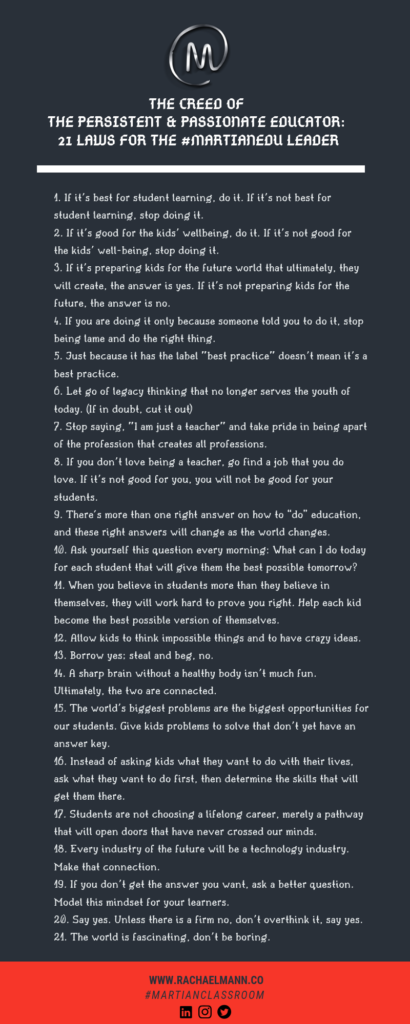
The biggest obstacles that we face as a society are the biggest opportunities for the Martians in our classrooms. Whether it is creating a “new” internet that is safe… finding a cure for cancer… creating the first habitat on Mars… or solving global warming… The Martians in our learning spaces will write the future and find the solutions that will ensure that our species will thrive. These big problems require Science, Technology, Engineering, and Math (STEM) solutions. STEM is in every content area! Let’s find ways to make it visible in every learning space while also blurring the lines between subjects.
But first, who are the Martians in your classroom? They are the youth of today, whether in your classroom, your community, or in your own home; and they could be the first Martian colonists! But more than that, young people are experiencing and interacting with the world around them in a way that is completely different than the world that we grew up in. In many senses, they are growing up in a different world altogether that might as well be on another planet than the world we experienced as kids. This means that we need an education system that meets the needs of this rapidly changing environment that they are growing up in, both on and off of planet Earth.
So what can you do, starting now, to help equip students for the exponential changes? Check out these 31 ways to be more Martian in your learning spaces.
31 Ways to Be More Martian, Starting Now!
- Missions to Mars will require a global effort. Begin connecting with #GridPals and let students connect with other Martians around the world!
- What will winter break be like in an interplanetary society? How will the start of a new school year be different in the future? Ask students to come with a response to one of these prompts and then have them choose how they will show what they know. Use one of these templates to create your own Show What You Know Learning Menus for students to choose from.
- Astronauts and robots worked together to repair the Hubble telescope. What are the advantages of humans working side by side with robots? What problems will we need to anticipate? What are the benefits? Ask students to come up with responses to these prompts and discuss the ideas that are generated as a class.
- Use these seven ideas for space-themed challenges to get students excited about learning and follow @DailySTEM for daily doses of STEM inspiration.
- On July 20, 2019, we celebrated the 50th anniversary of the Apollo 11 Moon landing and the first human on the moon. Fast forward to the 50th anniversary of the first humans landing on Mars. Ask students to imagine what life on Earth will be like because of spinoffs related to the Mars Mission. What is life like on Mars or other planets on the 50th anniversary?
- Have the Martians in your classroom visit the Voyager Golden Record web page and learn about this historical version of a time capsule. As a class, create your own Voyager Golden Record that represents the culture of your learning space and what a Martian classroom on another planet should know about you. Who are you? What do Martians in your classroom learn about? What does your class sound like? Look like? Feel like? Taste like?
- What questions would you like to ask an astronaut related to… math… history… science… (insert your content area). Have each Martian in your classroom come up with questions. Next, have them locate the contact information for an astronaut and send the information via email, social media, or even snail mail. See which astronaut responds first! Be sure to thank them for their response.
- Lots of conspiracies exist around the Moon landing. Have students study these and then look for scientific evidence to combat each one. Hold a class debate to help students master their ability to communicate big ideas!
- Just as the Moon landing inspired conspiracies, so will the mission to Mars. Give students an opportunity to think and write creatively by crafting their own Mars conspiracy theory.
- Have students come up with “Breaking News” headlines for the first step on planet Mars. As a class, vote for the best headline, then ask students to write a blurb in 240 characters or less related to the winning headline.
- How would our world be different if the moon landing had never occurred? Ask students to brainstorm as many responses as possible.
- The Martian Classroom looks beyond legacy thinking to ensure that students are equipped for the world that ultimately, they will create. Our current grading structure is one of the areas that we need to rethink in our learning spaces. Check out these nine ways to Ditch That Grade in your Martian Classroom.
- The Martian Classroom doesn’t rely on the classroom teacher to be the sole expert. Bring the world to your classroom via virtual guest speakers! Invite a content expert to speak to your class via a Google Hangout or Skype. Most successful individuals are eager to inspire the next generation and are appreciative of the time saved by appearing virtually. An added bonus is that this is an opportunity to prepare students for using technology to connect in a responsible manner.
- According to the Institute for the Future, 85 percent of jobs that will exist in 2030 haven’t been invented yet. That’s just 10 years away! Students who started second grade in the fall of 2019 will enter this new reality when they graduate from high school. For many, the concept of preparing youth for this future can be daunting and overwhelming. Focus on preparing the Martians in your classroom with skill sets that will open doors for jobs that haven’t been invented, and ultimately, prepare students to create this future reality! Instead of competing with robots, focus on what humans can do that robots and artificial intelligence cannot. Have students brainstorm the qualities and traits that make us unique as humans!
- To find out if a career path may be obsolete in the future, visit www.willrobotstakemyjob.com. While no one can guarantee the future, helping students discover how to predict and forecast will assist them in becoming #futureready!
- Gen Mars holds the next Martin Luther King’s and John F. Kennedy’s of the world. The Martians in your classroom may be the ones to change the course of history, but only if they are able to harness the power of their voice and communicate ideas in a way that garners the support and backing of others through both spoken and written word. Check out this blog post of resources to help empower student voice in your learning spaces.
- Who is Apollo named after? Artemis? Where did other Space programs get their names? Ask students to find the answer to these questions, and then decide what they would name a space mission and why.
- Check out the thousands of lessons and resources that are available for free on NASA’s website. Select one (or more!) that is related to your content area and add it to your plans for the upcoming school year.
- Ask the Martians in your classroom to think of an item you have used today. What’s its history? Where did it come from, and what problem does it solve? Will it continue to solve that problem? Are there other ways to solve the same problem or ways to improve the item?
- Educators can get certified to borrow lunar samples for their classrooms. Click here to find out how.
- Check out the press kits for Apollo and other missions, and then give your Martians an opportunity to design their own for the Mission to Mars.
- Astronauts value physical fitness. Challenge students to train like an astronaut and look up the workouts that they do. Have them design a workout that could be performed on a mission to Mars.
- Ask students to research a space mission and create a visual representation of their learning. Share out the creations on social media and tag @MartianEdu.
- Bring space entrepreneurship to your classroom! Ask students to develop and pitch a concept for a product or business connected to the next mission to the moon or Mars. Use Flipgrid for students to pitch their idea in three minutes or less. Take this a step further and send the link of the Flipgrid pitches business and industry partners to provide feedback to students.
- Ask students to select one doomsday scenario and come up with potential solutions to prevent or prepare for such a threat. Host a shark tank for students to share their ideas.
- Space exploration requires more than the ability to follow step-by-step instructions. It requires an inquiry mindset, exploration, invention, and discovery. Cultivate this mindset of problem-solving by creating a maker-mindset and tinkering environment in your learning space. Start here.
- Blur the lines between content areas by making STEM apart of every learning space. These resources from The Challenger Center are a great place to start!
- Curation is important in the Martian Classroom. One of our favorite curation tools is Wakelet. Check out this Wakelet Collection of ideas for curation in your learning spaces.
- Tell students that they are being sent to Mars and may only take seven items with them. These items could be for survival or sentimental to tell future generations what was left behind here on Earth. Discuss with a shoulder partner. As a class, discuss the choices, categorize them based on similarities, and then come up with top seven as a class.
- Artificial Intelligence, Virtual Reality, Augmented Reality, and other disruptive technologies will continue to impact every career path. Find ways to incorporate new technology in your classroom and to prepare students to be digital creators and responsible consumers. Invite Rachael Mann to create a customized, Martians in Your Classroom training for your district.
- How will your Martians tackle big problems that will make a huge impact? Have students answer this question by writing a letter to the future. Students will receive an email in the future that is from themself and will be an opportunity to reflect on what progress they have made in pursuing solutions to the big problems in the world.
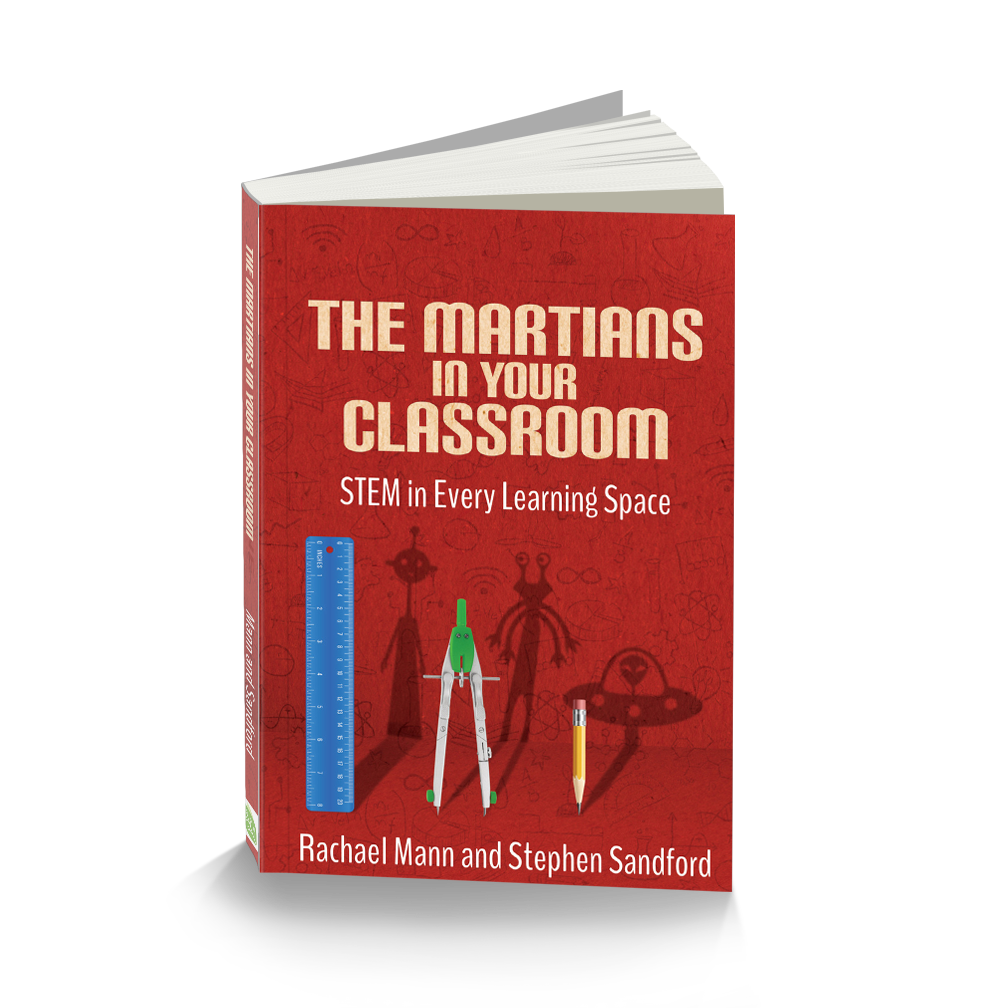
Want more ideas on how to be more Martian in your learning spaces? Get Your Copy ofThe Martians in Your Classroom for more great content and resources to ensure that your students are future-ready! Follow @RachaelEdu and #MartianClassroom for more ways to #BeMoreMartian.